
Can a witness authenticate a video if the video contains images that the witness did not see?
A Protective Order Has Teeth – Counsel Disqualified After Court Finds Violations
August 15, 2024StubHub: “The Court is not going to do that.”
August 16, 2024Can a witness authenticate a video if the video contains images that the witness did not see? In Mooney v. State, __ Md. __, 2024 WL 3766058 (Aug. 15, 2024), the Maryland Supreme Court answered in the affirmative. Here, the authenticating witness saw what happened before and after the shooting, as shown on the video, but he did not see the shooting that was also shown on the video. That before-and-after authentication, plus a few other facts, was sufficient circumstantial evidence to authenticate the entire video. The dissenting Justice called that a “sandwich” analysis.
The Mooney Court addressed two key issues. First can video evidence be authenticated when the authenticating witness lacked personal knowledge of all of the events portrayed in it? Second, what is the standard governing sufficiency of the authenticating evidence?
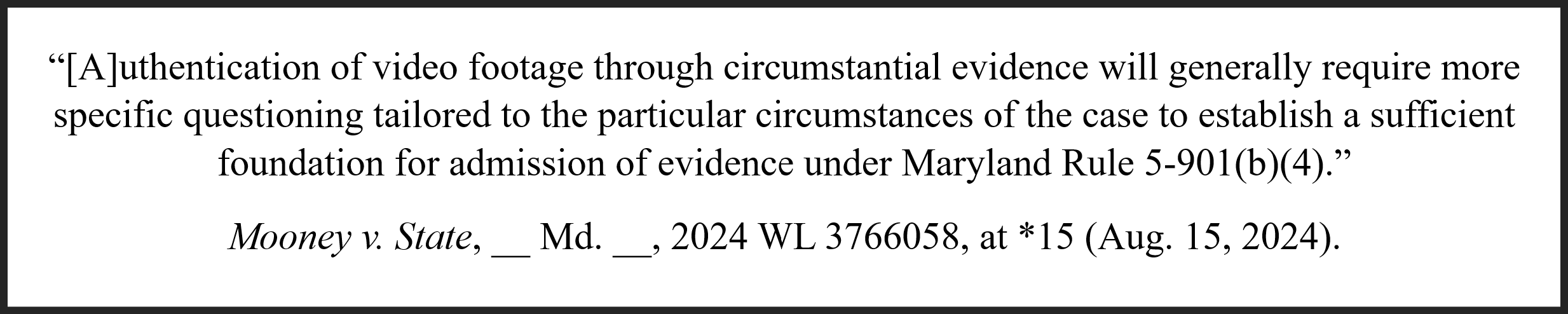
Mooney v. State, __ Md. __, 2024 WL 3766058 (Aug. 15, 2024).
The facts were straightforward. Victim Zimmerman believed that defendant Mooney was sleeping with Zimmerman’s “girlfriend.” Id. at *2, 4. Zimmerman was sitting in his truck in Baltimore City. Mooney walked up and words were exchanged. Id. at *4. Mooney kept walking. Zimmerman sat in his truck with his back to Mooney. Zimmerman was then shot from behind. He got out and saw Mooney running away. Zimmerman then went into a fast-food restaurant for help.
That night, a Baltimore City police detective obtained a Ring camera video from a nearby residence. The 1 minute, 51 second, video showed Mooney’s approach, the shooting, and some of the follow up. At trial, the officer explained how he obtained the video.
Zimmerman’s testimony was used to authenticate the video. He testified that the video was “true and accurate” and did not appear to have been altered. While the Court quotes all of the key testimony, in part Zimmerman testified as follows:
[PROSECUTOR]: [Zimmerman] has watched it in view, in preparation of this trial, he has —
THE COURT: Well, you — you can ask him all that before, you haven’t laid the appropriate foundation for it yet. I don’t know if that video —
[PROSECUTOR]: He’s authenticated it as to be the date and the time of the incident, it was a true and accurate reflection of that date and time.
THE COURT: There are other questions you need to ask him, like, has he watched it.
[PROSECUTOR]: Okay.
THE COURT: And is it a fair and accurate representation of what happened. I mean, I’m not trying —
[PROSECUTOR]: Okay.
THE COURT: Ask some more foundational questions.
[PROSECUTOR]: Sure.
….
[PROSECUTOR:] Okay. And after seeing that video[,] was that a true and accurate depiction of the events that occurred that day?[1]
[MR. ZIMMERMAN:] Yes.
[PROSECUTOR:] Okay. And it’s a true depiction of what you recall?
[MR. ZIMMERMAN:] Yes.
[PROSECUTOR:] It doesn’t look like there’s been any alterations or edits –
[MR. ZIMMERMAN:] Absolutely.
[PROSECUTOR:] — to it? Okay.
The defendant/appellant argued that there were only two methods of authentication of video. The Supreme Court disagreed and reiterated that several theories of authentication had been established. Id. at *1, passim.
First, a proponent can use the “pictorial testimony” theory through a witness who has first-hand knowledge that the video fairly and accurately represents the scene at the relevant time. See Md. Rule 5-901(b)(1).
Second, the “silent witness” theory is available. In that instance the proponent offers testimony that the video recording system was reliable and produced an accurate result. See Md. Rule 5-901(b)(9); The “Silent Witness” Theory of Authentication of Video Evidence (July 5, 2024)(“Under the ‘silent witness’ theory, a party can authenticate video evidence through ‘presentation of evidence describing a process or system that produces an accurate result.’”).
Third, video may be authenticated as a business record under Rules 5-803(b)(6) and 5-902(12). This requires showing that it was the regular practice of the business to make and keep the video.
Fourth, the Court added that:
In addition, we hold that, like other evidence, video footage can be authenticated in a variety of ways, including through circumstantial evidence under Maryland Rule 5-901(b)(4).
Id. at *3.
Fifth, the Court wrote that “[t]hese circumstances are not intended to be exhaustive or all inclusive of the circumstances that may permit authentication of video footage under Maryland Rule 5-901(b)(4). The authentication of video footage involves a fact-specific inquiry that will vary from case to case.” Id.; accord id. at n. 13 (these are “not the only ways….”).
Applying these standards, the Court held that the video was properly authenticated: “The parts of the video depicting the events that Mr. Zimmerman saw, or participated in, before and after the shooting were properly authenticated through his testimony under Maryland Rule 5-901(b)(1) as a witness with personal knowledge of the events.” Id. The “nature and origin” was important – the video came from a third-party[2] that was not connected with law enforcement or the shooting. Id. There was close temporal proximity between the shooting and the before-and-after events. Id. The detective obtained the video on the night of the shooting. Id. at *14. Zimmerman recognized his vehicle, a nearby building, and a parking lot in the video. Id. at *4. The video was short. Id. at *14. Another video showed Mooney in front of an SUV and a third showed Zimmerman post-shooting in the fast-food restaurant. Id.
“The bar for authentication of evidence is not high.” Id. And, “it is worth observing,” the Court wrote, that Mooney “did not allege that the video was altered or tampered with.” Id. at *14.
In sum, the Court wrote:
We have not previously addressed whether a video can be authenticated through circumstantial evidence under Maryland Rule 5-901(b)(4) or whether the “reasonable juror” test applies to authentication of video evidence—i.e., these are matters of first impression. We now unequivocally hold that the “reasonable juror” test applies to authentication of videos, just as it does to authentication of social media evidence and other evidence. … We conclude that, for a trial court to admit a video, there must be sufficient evidence for a reasonable juror to find by a preponderance of the evidence that the video is authentic. We also hold that a video can be authenticated through circumstantial evidence under Maryland Rule 5-901(b)(4).
Further, the Court expressly authorized use of a combination of theories. Id. at *14.
There need not be a witness with personal knowledge of every single event depicted in a video for the video to be authenticated…. To be sure, Mr. Zimmerman did not testify that he saw the shooting, and he lacked firsthand knowledge of who the shooter was. Even so, the part of the video depicting the shooting was properly authenticated through circumstantial evidence.
Id.
In a March 1st blog, Authentication of Entire Video When Witness Observed Only Part of the Events Portrayed in the Video, I described the intermediate appellate court’s decision. I pointed out that there was no specific objection by the defendant to the key question of “was that a true and accurate depiction of the events that occurred that day?” I speculated that, if there had been an objection based on a lack of personal knowledge under Md. Rule 5-602, it might have been sustained. I then posited a scenario under which a circumstantial evidence argument was made by the hypothetical prosecutor and a Rule 5-104 “gatekeeper” decision was presented.
I suggest that the Maryland Supreme Court wrote that the low bar of authentication had barely been cleared. The Court wrote:
While there was sufficient evidence for a reasonable juror to find in favor of authentication in this case, authentication of video footage through circumstantial evidence under Maryland Rule 5-901(b)(4) will generally require more fulsome questioning than the type of inquiry typically used to establish the necessary foundation for authentication under Maryland Rule 5-901(b)(1), where a witness may be asked if the item is a fair an accurate depiction of what it purports to be. To be sure, in this case, the prosecutor asked Mr. Zimmerman whether the video showed what he knew to be the 3900 block of Falls Road and confirmed with Mr. Zimmerman that the video showed him in his vehicle. And, after a bench conference at which the circuit court questioned whether a proper foundation had been laid for admission of the video, the prosecutor asked Mr. Zimmerman if he had watched the video and if the video was a true and accurate depiction of the events that occurred on the night of the shooting. Although these were certainly valid questions and are the type of questions typically associated with authenticating evidence under Maryland Rule 5-901(b)(1), authentication of video footage through circumstantial evidence will generally require more specific questioning tailored to the particular circumstances of the case to establish a sufficient foundation for admission of evidence under Maryland Rule 5-901(b)(4).
Id. at *15 (emphasis added). However, on the other facts presented, in this case “the absence of more specific questioning, generating additional circumstantial evidence to corroborate events in the video, does not detract from our ability to conclude that the video was properly authenticated.”
In what I would call a dialog with the concurring Justice, the Majority acknowledged that video evidence is “susceptible to alteration,” however, “at this time, video footage can be authenticated through vigilant application of existing methods for authentication of evidence.” The concurring opinion pointed to the risk of fabrication and added: “But the record in this case does not contain any hint that artificial intelligence may have played a role, nor was there any suggestion that the video may have been altered in any way. We can expect to need to tackle issues associated with artificial intelligence soon, but this is not the case.” Id. at *16.
The dissent asserted that “[t]hose critical few seconds [of the shooting] were not authenticated” by any method. Id. at *16. “The problem here is that Mr. Zimmerman did not see Mr. Mooney after he walked past Mr. Zimmerman’s car.” Id. at *17. The dissent rejected the Majority’s “sandwich” analysis. Id. at *18 (“the fact that Mr. Zimmerman can authenticate the parts he did see does not mean the parts he could not see were untampered with.”). The dissenting Justice wrote:
In sum, the most critical part of the video—the shooting—was not properly authenticated using the pictorial testimony method, the silent witness method, or with other circumstantial evidence. In my view, that part of the video should not have been admitted. I would therefore reverse and remand the case for a new trial.
Id. at *21.
The dissent also wrote that, at trial, the State relied solely on the “pictorial testimony” method. Id. at *16. Additionally, the dissent argued that the evidence was insufficient under the “silent witness” theory. Id. at 19. It also argued that the record was silent as to when the detective obtained the video and how he obtained it. Id. at *20. The dissent wrote:
There is much we do not know, but should know, to be consistent with the standard this Court has set for the “silent witness” approach to authenticating photos or videos. Which type of camera was used? What media was used to record the images? Where were the images from the camera stored? Did Detective Liu receive a copy of the video or the original? If it was a copy, who made the copy, and when and how was it made? Was the video emailed to Detective Liu? Did he receive a thumb drive? Was Detective Liu given access to a cloud account where the video was stored? Was the video recorded in a format that made it easy to alter? Who had access to the video before it was provided to Detective Liu? Who had access to the video after Detective Liu received it? The inability to answer these questions on this record is troubling, in my view, particularly when compared to other cases in which video evidence was admitted or excluded.
Id. at *20.[3]
____
[1] No specific objection was made to this question.
[2] The identity of the local resident was not contained in the record. Id. at *15.
[3] In its brief, the State cited 45 unreported decisions. 2024 WL 3766058, at *3; Maryland’s New and Improved Unreported Opinion Rule Does Not Go Far Enough, citing Respondent’s Brief, Mooney v. State, No. 0032, Sept. Term, 2023, at 28, passim. That citation likely did not comport with Md. Rule 1-104; however, the Mooney Court referred only to reported decisions. Id. at n. 11.
