
No Sanction for Discovery Failure in Criminal Case
StubHub: Modification of ESI Protocol and Denial of Sanctions – Performance Was Impossible
May 23, 2024Court Holds Privilege Was Waived by Failure to Timely Provide a Privilege Log
May 30, 2024Bernard Stanford was convicted of first-degree murder and other crimes. He appealed. Stanford v. State, 2024 WL 2520794 (App. Ct. Md. May 24, 2024)(unreported). Surveillance video showed him shooting a man at a gas station. He asserted self defense.
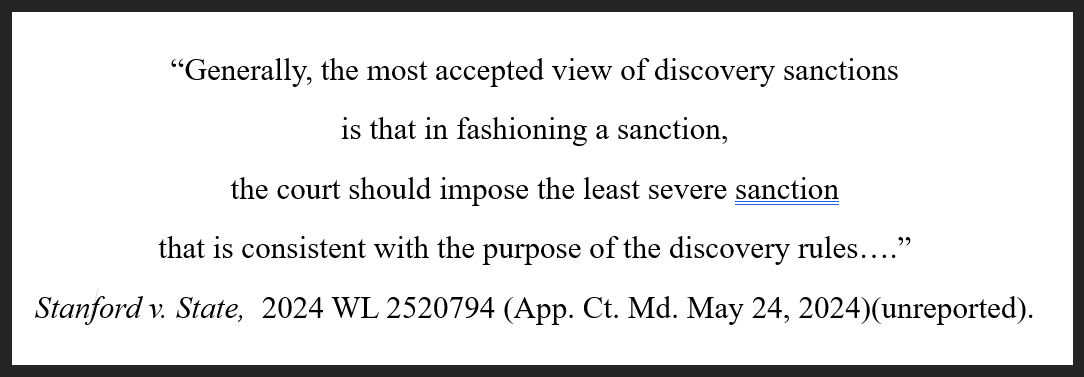
Standford v. State, 2024 WL 2520794 (App. Ct. Md. May 24, 2024)(unreported).
On appeal, Stanford asserted a failure to preclude witness testimony for a discovery violation: The Court wrote: “At the beginning of the second day of trial, defense counsel informed the trial court that the prosecutor had just notified the defense that the State intended to call Amarjeet Sandhu, the owner of the Crown gas station, as a witness in the State’s case-in-chief. Defense counsel asked the court to preclude Sandhu from testifying in light of the State’s late disclosure.”
In response, “the prosecutor proffered that Sandhu was named in the supplemental discovery documents, which had been disclosed several weeks before the start of trial, but candidly acknowledged that the State had not indicated its intention to call Sandhu as a witness at that time. The prosecutor added that Sandhu’s testimony would be limited to confirming that the surveillance equipment at the Crown gas station, which provided the bulk of the footage depicting the shooting, had been properly maintained. The prosecutor explained that the actual video would be authenticated by Detective Ohmstede.”
The trial court did “not find the existence of any unfair surprise or ambush with regard to this anticipated limited testimony.” The trial judge stated: “And certainly if you [defense counsel] want a little break to investigate him, to examine him, meaning outside of the courtroom, you know, to in any way interview him to prepare for the cross-examination, the Court would be happy to give you time to do that in an abundance of caution.”
Defense counsel declined, and:
Sandhu thereafter testified as to the history and operability of the surveillance system at the Crown gas station. Later, during the testimony of Detective Ohmstede, the State moved to introduce the video footage depicting the exterior of the Crown gas station and the surrounding area around the time of the shooting. Stanford did not object; to the contrary, Stanford conceded that the footage could be properly authenticated through Detective Ohmstede and that the footage was “admissible evidence.” When the trial court proposed that the footage be admitted “by stipulation,” Stanford agreed. The court then informed the jury that the footage would be admitted based on the parties’ stipulation.
On appeal, Standford asserted failure to impose a discovery sanction – specifically, the failure to preclude Sandhu’s testimony.
Initially, the Court held that the stipulation to the video’s admissibility waived the objection.
It then went on to “also reject Stanford’s claim on its merits.” Md. Rule 4-263 requires disclosure of the State’s witnesses prior to trial and that is a continuing obligation. “The primary purpose of the discovery rule is to protect the defendant from surprise and to permit the defendant to mount an adequate defense.” Id. at *3. The Court wrote that:
If the State fails to meet its discovery obligations, the court may order the State “to permit the discovery of the matters not previously disclosed, strike the testimony to which the undisclosed matter relates, grant a reasonable continuance, prohibit the [State] from introducing in evidence the matter not disclosed, grant a mistrial, or enter any other order appropriate under the circumstances.” Md. Rule 4-263(n). “The decision as to which remedy or sanction to impose generally rests within the broad discretion of the trial court.” Williams v. State, 416 Md. 670, 698 (2010). “This discretion extends to deciding whether to grant or deny a motion to disqualify a witness from testifying based upon a party’s failure to comply with discovery obligations.”
The Appeals Court then enunciated the factors to consider:
When exercising that discretion, a court should consider (1) the reasons why the disclosure was not made; (2) the existence and amount of any prejudice to the opposing party; (3) the feasibility of curing any prejudice with a continuance; and (4) any other relevant circumstances. [quotations and citation omitted].
It added:
Generally, the most accepted view of discovery sanctions is that in fashioning a sanction, the court should impose the least severe sanction that is consistent with the purpose of the discovery rules, … which is to give a defendant the necessary time to prepare a full and adequate defense…. In fact, [t]he rule ‘does not require the court to take any particular action or any action at all. [cleaned up; quotations and citations omitted; emphasis in original].
On the facts presented, the appellate court held that the trial court did not abuse its discretion, noting, in part, defense counsel’s rejection of the offered continuance and the lack of unfair surprise.
